Advisory Board
The Picturing Climate Network is proud to have an esteemed advisory board composed of experienced professionals working within the domains of climate science, museums and heritage, the arts and policy expertise. Their knowledge helps frame the direction of our various projects and ambitions, as well as bringing awareness to the importance of our work to broader audiences.

Advisory Board Member (EASE Project)
Miranda Massie
The Climate Museum
Miranda Massie is the founding director of the Climate Museum. She left an award-winning career in social justice litigation to launch the Museum, which in 2018 had its breakout year of public programming. The Museum has since presented arts-centered exhibitions and other free cultural programs to build agency and community on climate throughout New York City and beyond.
Massie has pioneered an approach to community engagement with climate that blends arts, storytelling, culture, and activism, successfully empowering visitors in the large majority who are worried about climate change but unsure what to do. She is recognised as a national and international leader at the crossroads of culture and climate change.

Advisory Board Member (EASE Project)
Louise Fedotov-Clements
Director of Photoworks, Vice Chair of Inspirate and Co-Director of Earth Photo
Louise has been the Director of Photoworks since 2023, where she leads the strategic vision and artistic direction of the organisation. Established in 1995, Photoworks is an international platform focused on the development of photography through a programme of exhibitions, residencies, publications, engagement, the biennale Photoworks Festival, the Ampersand Photography Fellowship and the Jerwood Photography Awards.
She is the CoFounder/former Director of FORMAT Festival. Previously, she was Artistic Director of QUAD, a centre for contemporary art and film; National Curator of Contemporary Art, Forestry England, and currently Jury Chair of Earth Photo with the Royal Geographical Society, Forestry England and Parker Harris.
As a creative director since 1998, Louise has curated commissions, festivals, publications, mass-participation events, film/photography programmes/exhibitions, and juried and mentored worldwide.

Advisory Board Member (EASE Project)
Catherine Polcz
Planet Kingdom
Catherine Polcz is a curator, artist and creative producer working across museums and media specialising in climate and the natural world. She was born in Canada and since 2015 has lived and worked in Sydney on Gadigal land. Drawing on her background as a botanist and ecologist, she has conceived and produced content for science festivals, events and panel discussions and has exhibited her own work at artist centres in Canada, US and Australia. From 2018-2024, she was the science program curator at the Powerhouse Museum and Sydney Observatory, where was the curator of 100 Climate Conversations. She has also worked with the Botanic Gradens of Sydney, Redpath Museum (Montreal) and the Royal Ontario Museum. Her professional practice seeks to bridge the science and cultural sector on issues of climate, ecology, evolution and conservation.
Instagram: @plantkingdom.earth
LinkedIn: https://www.linkedin.com/in/catherine-polcz-755aaba4/
Advisory Board Member (EASE Project)
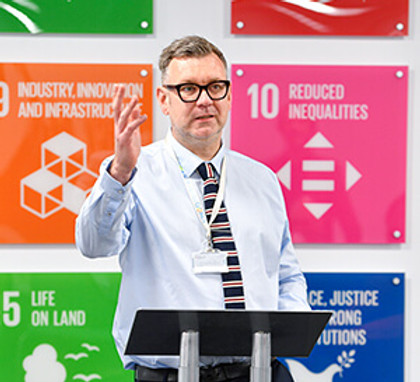
Dr. Mark Charlton
De Montfort University
Dr Mark Charlton is an Associate Professor of Sustainable Development and leads the United Nations Academic Impact Global Hub Chair for Sustainable Development Goal 11, based at De Montfort University. Mark also teaches sustainable development politics in the department of Politics. His current research looks at efforts to tackle climate change in marginalised communities. He is also working with young people in the United Kingdom and beyond on projects to help understand the challenges faced by those affected by climate issues and forced migration. Much of Mark’s work promotes just climate transitions, with a particular emphasis on supporting refugee populations and other vulnerable groups. Mark is passionate about driving systemic change through inclusive, sustainable, and democratic practices that empower marginalised voices.

Advisory Board Member (EASE Project)
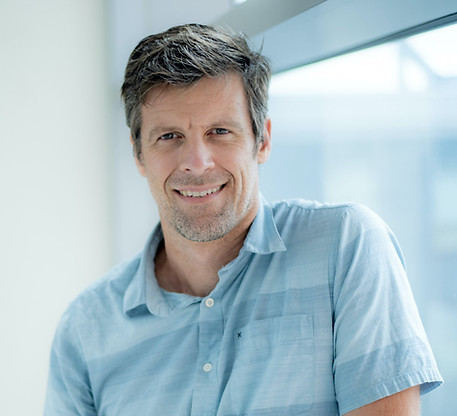
Dr. Kathleen Johnson
UC Irvine
Dr Kathleen Johnson (Grand Traverse Band of Ottawa and Chippewa Indians) is a geochemist and paleoclimatologist specialising in reconstructing past climate using isotopic and geochemical variations preserved in cave calcite formations (speleothems), such as stalagmites. Dr Johnson is currently a Professor in the Department of Earth System Science and Equity Advisor for the School of Physical Sciences at the University of California, Irvine. She also serves as PI and Director for the UCI CLIMATE Justice Initiative.
Dr Johnson's lab is currently conducting process-based studies of new and emerging speleothem proxies, and developing multi-proxy speleothem records of past hydroclimate variability from seasonal to orbital timescales. Her research helps improve understanding of the hydroclimate response to external forcing (e.g. greenhouse gases, orbital changes) and internal climate variability (e.g. ENSO), which can help separate natural from human-caused climate change and lead to improved climate model projections of future rainfall changes. Our current and former study areas include California, China, Mexico, Laos, and Vietnam.
Advisory Board Member (EASE Project)
Dr. Michael Griffiths
William Paterson University
Michael Griffiths is a professor of environmental science at William Paterson University and director of the Past Climate and Ecosystems Lab. His research interests can be divided into two key areas: (1) the first is centred around the use of biogeochemical tracers in sedimentary archives (e.g., cave deposits, terrestrial and marine fossil teeth, corals) to explore changes in Earth’s biogeochemical cycles and, by extension, the evolution of Earth’s systems. He is particularly interested in building records of past environmental, climatic, and ecological change over various time scales ranging from the last few hundred years to the last ~100 million years; (2) the second is primarily focused on utilising climate model simulations of the past to assess mechanisms, test hypotheses, and in turn help to answer fundamental questions in climate science.