Immersive Environments
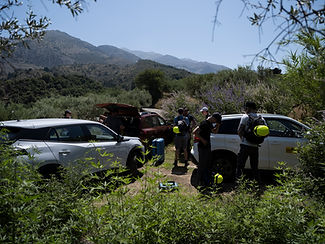
The final Crete lab moves into the gorges and caves of Sfakia, one of Crete's most rugged and remote regions. Fieldwork includes LiDAR scanning and possible coring of an ephemeral lake in the Aradena gorge, drip-water sampling and palaeontology in the Drakolaki and Skoteini caves, and visits to a cave shrine. These generate spatial data that can be walked through as well as read. Participants explore how point clouds, spatial audio, XR and physical installation can turn scientific survey into embodied experience, so audiences can stand inside a landscape's climate history. As the closing lab, it also gathers threads from the previous four. That positions immersive prototypes for public testing in gallery, museum and touring-exhibition settings.
Lab Participants
Learn more about this labs participants by clicking on their image. Many of the researchers and partners work on several labs, and these connections are shown below.
Lab Journal and Updates
Throughout the lab, researchers, artists and partners reflect on their involvement in the project. View and follow lab updates here in the form of our shared lab journal.
Materiality: clay, stone and deep time in the potters' village of Margarites
10/10/26
Update
The EASE team
Author
The second EASE Artist Venturing Lab runs from 25 October to 1 November, following material through deep time: from cave scans and Bronze Age kilns to Minoan tombs, ancient trade and weaving.

Entanglements: a week in the caves, palaces and mountains of central Crete
10/10/26
Update
The EASE team
Author
On 18 October, artists, scientists and researchers gather in Zaros, below Mount Psiloritis, for the first EASE Artist Venturing Lab. Here is the week ahead, from live cave monitoring to the mountain cave of Zeus.
Lab journal content not yet available, but will be added after the lab start dates.